Plants and pipelines
Industrial Electricians in Payne County
Power distribution, panel installation, and site-wide lighting for plants, pipelines, and yards around Cushing.
Chapter 01
Why an industrial panel is not a big house panel
Due to its unique environment and major power needs, an industrial electrical system requires an electrician with a particular set of skills. A house panel gets a service upgrade every decade or two and spends most of its life sitting well under capacity. A panel feeding a plant or a pipeline yard carries real, continuous load every working day, and it has to carry it without tripping the rest of the operation, no matter what else on the site draws power at the same moment.
Power distribution across a site like that means more than one panel. A main service feeds sub-panels spread across buildings and yard equipment, and the load on each one has to be worked out before anything gets energized, not adjusted afterward by trial and error once a breaker has already tripped mid-shift.
Panel installation gets sized against what the site actually runs, not against a standard residential table. Award Electrical Service, Inc. has been sizing that kind of load since 2007, on Payne County plants and pipeline sites where a wrong guess costs a production day, not a blown fuse and a trip to the hardware store.
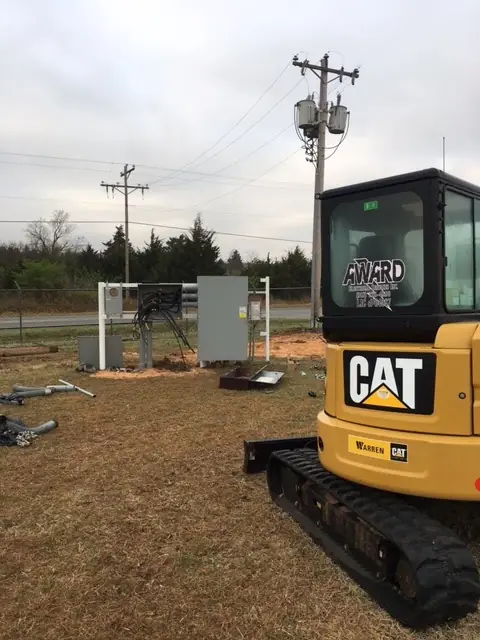
Award mini-excavator parked beside a freshly installed utility panel and meter bank at a roadside site
Design and build, from the trench up
Design and build work starts with excavation, not with a panel bolted to a wall. The company runs its own mini-excavator and skid steer, so the trench for a conduit run is planned and dug by the same crew that lands the panel at the end of it, rather than handed off between a digging outfit and an electrical outfit that have never worked the same site.
That matters on an industrial site where a run has to clear existing lines, footings, and equipment pads before a single wire gets pulled. The design gets walked against what is actually in the ground first, on foot, with the excavator staged and waiting rather than already cutting into unmarked ground.
Plan first, dig once, land the gear where the design says it goes. That order keeps a plant or pipeline job from opening the same trench twice because a run was placed before the ground underneath it was checked, which is the expensive way to find out a line moved since the site was last mapped.
Chapter 03
Moving a plant without losing a shift
Complete business relocation sits on the industrial list because moving a working plant is an electrical project before it is a moving-truck project. Power has to be live and tested at the new site close to the moment it goes dark at the old one, or the move costs more in downtime than in freight.
Award Electrical Service, Inc. sequences that kind of move so panels, feeders, and equipment hookups are built out and ready before the last load leaves the old building. The relocation gets planned around the operation's own schedule, floor by floor and circuit by circuit, instead of the operation being forced to work around a moving date it did not choose.
Twenty years of experience means that sequence has already been worked out on jobs like it. The gap between the old panel going dead and the new one taking load is the number that matters most on a relocation, and it gets planned down to hours, not days, before the first piece of equipment is unbolted.
Lighting a site that never fully stops
Indoor and outdoor lighting on an industrial site covers the working floor and the yard around it, everywhere a crew still has to see clearly after the sun goes down. A plant that runs shifts past dark cannot treat interior and exterior lighting as two separate jobs bid at two separate times by two separate contractors, each one guessing at what the other one wired.
Security lighting covers the same yard once the last shift has gone home for the night. It is wired off the same distribution the working lights use, on a schedule that has nothing to do with whether anyone is actually standing under it at the time, and it draws from the panel sized for the site, not from a separate circuit added on later.
That is the same crew and the same panel work described above, extended out to every fixture on the property line, indoors, outdoors, and after hours, on one circuit plan instead of three unrelated ones bolted together over the years by whoever was available at the time.
Award Electrical Service, Inc. Licensed and insured. Oklahoma electrical contractor license #64087. Call 918-225-4500.