Storefronts and shops
Commercial electricians for storefronts and shops in Payne County
Bucket truck work on signs, poles and canopy lighting, remodeling rewiring scheduled around your open hours, security and landscape lighting, plus generators and excavating for commercial sites across Payne County.
Chapter 01
Minimal disruption to your operations means the schedule bends, not your hours
Providing quality electrical work at competitive prices since 2007 doesn't mean much if getting it done shuts a storefront for a week. Minimal disruption to your operations is the standard we build the schedule around, and in practice that means relocating existing wiring and remodeling rewiring get sequenced to your open sign, not the other way around. We'd rather work an early morning or a slow Tuesday than close your doors on a Saturday. Losing a day of foot traffic costs more than the repair itself.
A retail remodel that moves a wall usually means moving the wiring behind it too, sometimes the whole run feeding a register bank, a cooler, or a point of sale terminal. We map which circuits go dark and for how long before the first wall comes down, so you can tell your staff and your customers exactly what to expect instead of finding out when the lights go out mid-shift. That map goes to you in writing, not just in our heads.
That planning conversation happens before we show up with tools, not after. A schedule you agreed to in advance is the difference between minimal disruption and a surprise, and it's the same conversation whether the job is a two hour ballast swap or a two week remodel behind your sales floor.
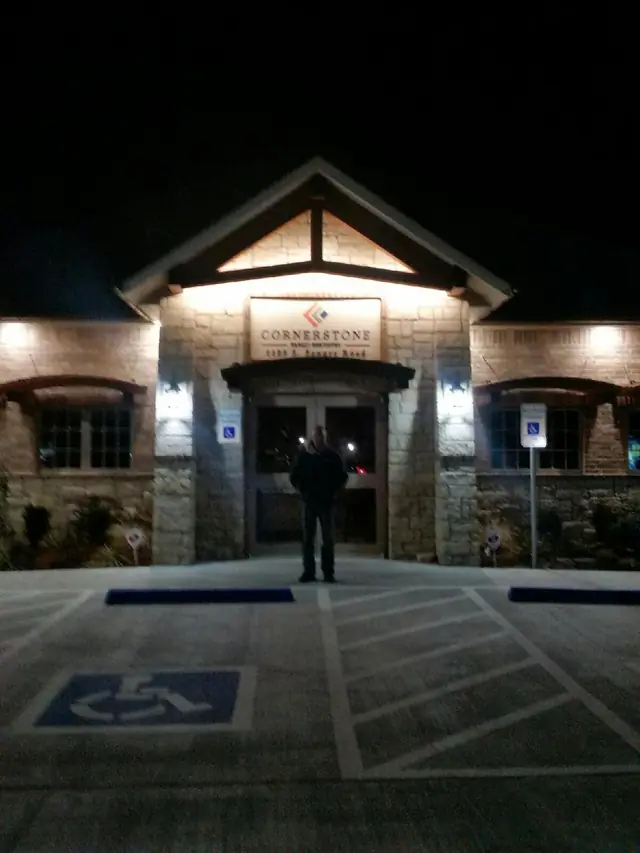
Completed exterior and sign lighting lit at night on the Cornerstone Family Dentistry storefront
Everything above head height needs the bucket truck
Outdoor lighting poles and signs, canopy lighting over a fuel island or a drive-through, fluorescent ballast changes in a warehouse ceiling. Three different jobs on paper, one piece of equipment in practice. A bucket truck is what puts a technician safely at pole height or under a canopy deck without a rental lift showing up for a single afternoon's work, and it's why those three bullets live under one roof instead of three separate trades. Renting that lift alone can cost more than the repair it's there for.
That's why one crew can handle a sign repair and a ballast swap on the same site visit instead of a business calling two different companies for two different heights. If the fix is overhead, whether it's a pole thirty feet up or a ballast bolted to a ten foot ceiling, it comes off the same truck that's already parked out front. One invoice, one crew, one afternoon instead of two separate visits weeks apart.
That's also why the truck shows up first on any punch list that includes something overhead. There's no separate quote for a lift rental, no second visit for the ballast once the sign guy's already up there for something else. One vehicle, one crew, one trip out. It keeps the punch list short and the invoice simple.
Chapter 03
Lighting that has to still be on when you lock up
Security lighting and landscape lighting do their real work after the doors close, when nobody's inside to notice a dark corner of the lot until it actually matters. We check these circuits on their own schedule instead of folding them into a daytime service call, because a fixture that looks fine at noon in full sun can still be dead by nine at night when the parking lot needs it most. A quick daytime glance can't tell you what the lot looks like after dark.
A dark lot or a storefront that goes black at closing is a liability question as much as an electrical one. We treat landscape and security lighting as its own line item, checked and photographed after dark rather than assumed to be working just because the sun was up the last time anyone looked at it. A photo after dark is proof the lighting actually works, not just that it's wired.
Where the trench goes on a commercial site
Excavating and generators go together on a commercial site the same way they do on a house, just at a bigger scale. A new generator pad, a feed run to a relocated panel, a trench out to a new pole sign, all of it starts with digging, and we dig our own with the same excavator and skid steer we use across every job type, residential or commercial. One machine, one crew, whether the job's behind a house or behind a storefront.
Planning the run before we cut into a parking lot or a landscaped strip matters more here than at a house, because a commercial trench usually crosses ground a dozen other people walk across every day. We mark it, dig it, and close it back up on a schedule that doesn't leave a hole open longer than the work actually requires. A trench held open past closing time is a liability nobody needs.
Award Electrical, Licensed and insured. Oklahoma electrical contractor license #64087. Call 918-225-4500.